October 11, 2026
QR Codes for Sports and Leisure Facilities: Showcase Your Activities, Prices, Menus and Events
Discover how QR Codes help sports and leisure facilities, climbing gyms, virtual reality centers, go-kart tracks, bowling alleys, laser tag arenas and trampoline parks centralize their information and highlight their services. Activities, prices, bookings, menus, bar cards, additional services and events: give your visitors simple and quick access to all your information from their smartphones.
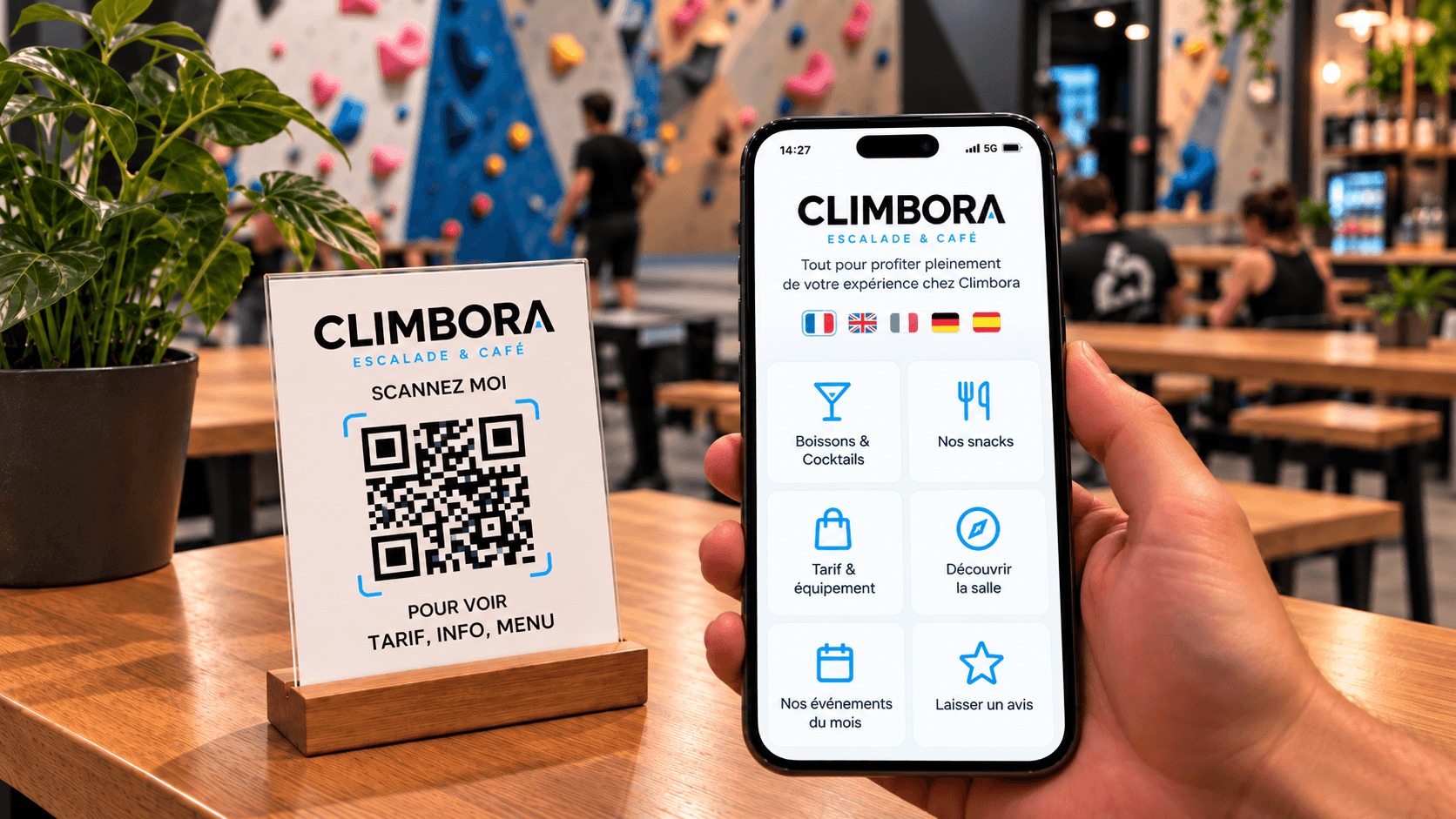
QR Codes for Sports and Leisure Facilities: Showcase Your Activities, Prices, Menus and Events
Sports and leisure facilities often extend beyond their main activity. Whether it's a climbing gym, virtual reality center, go-kart track, bowling alley or laser tag arena, some establishments also offer complementary services: bar, food and beverage, relaxation areas or additional activities.
A climbing gym may for example have a café, dining area or sauna. A virtual reality center may offer a bar, billiards, table football or darts, allowing visitors to extend their experience.
Added to this are events, special offers, prices, opening hours and practical information that establishments must regularly communicate to their customers.
How can you make all this information easily accessible while highlighting the various services your facility offers?
With a QR Code linked to a digital page, centralize your information, showcase your services and allow your visitors to discover them directly from their smartphones. A simple solution to improve customer experience and streamline communication within your facility.
1. A QR Code suited to different sports and leisure facilities
Each facility has its own activities, services and communication needs.
The QR Code should not be viewed as a solution reserved only for large multi-activity complexes. It can be equally interesting for facilities specializing in a single activity.
For climbing gyms and bouldering walls
A climbing gym can use a QR Code to present its prices, memberships, opening hours, different areas and equipment needed for climbing.
If it has a bar, dining area or sauna, these services can also be highlighted on the same digital page.
Visitors can discover all available services without having to search for information across multiple platforms.
For virtual reality centers
Virtual reality specialists typically offer different experiences, sessions and booking options.
Some also have social areas with darts, billiards, table football or a bar.
Through the QR Code, visitors can find available experiences, prices, booking links as well as any complementary activities and services.
A way to promote the facility beyond just its virtual reality experiences.
For go-kart facilities
Go-kart centers can present their different packages: individual sessions, races with friends, group offers, birthday parties or corporate events.
The QR Code can also provide access to practical information, participation conditions and required equipment.
If a bar or dining area is available, visitors can check the menu while waiting or after their session.
For bowling alleys, laser tag arenas and trampoline parks
These facilities often host families, groups of friends and private events.
A QR Code can allow visitors to check prices, different packages, opening hours, booking options and birthday offers.
When a facility offers a bar, snacks or other activities, these can be presented on the same page.
Regardless of facility type, the goal remains the same: make information easy to access while giving greater visibility to the services you actually offer.
2. Centralize activities, prices and practical information
In a sports or leisure facility, visitors may need different information before, during and after their activity.
This information is sometimes scattered across your website, posters, printed documents and explanations at reception.
By installing a QR Code in your facility, you can provide direct access to a page containing your main information:
- Activities: presentation of your experiences, facilities and available services.
- Prices: session fees, memberships, packages and group offers.
- Opening hours: opening times and specific hours for certain services.
- Bookings: direct link to your booking platform.
- Equipment: necessary equipment, rentals or on-site equipment provided.
- Practical information: access conditions, recommendations and guidelines.
- Additional services: bar, food and beverage, relaxation or supplementary activities depending on your facility.
- Events: special evenings, competitions, entertainment and occasional offers.
Visitors can access this information directly from their phone without installing any additional apps.
This centralization makes information more accessible and simplifies its retrieval.
3. Highlight your facility's complementary services
One of the main advantages of QR Codes is not limiting communication to your main activity.
A customer coming for a virtual reality session may not know they can also enjoy billiards, table football or a bar area.
Similarly, a climbing gym visitor may be unaware that a dining or relaxation area is available.
A QR Code allows you to present these services on one page and encourage visitors to discover more offerings.
Promote additional activities
Depending on your facility, you can notably present:
- A billiards or table football area.
- Darts games.
- A sauna or relaxation space.
- Additional activities.
- Group offers and combined packages.
- A shop or equipment rental service.
Each section can present essential information and, where relevant, a link to booking or a dedicated page.
Highlight beverages and food service
Facilities with a bar or dining area can also use their QR Code to share their menu.
Cocktails, non-alcoholic drinks, coffee, snacks, pizzas, burgers or sharing platters can be viewed directly from a smartphone.
By placing a QR Code on tables, at reception or in a waiting area, visitors can access the menu without having to repeatedly request a paper copy.
This added visibility can encourage spending and help develop supplementary sales.
4. Promote your events and entertainment through QR Codes
Events are also an opportunity to boost attendance at sports and leisure facilities.
A climbing gym can organize a competition or themed evening. A virtual reality center can host a tournament, while a bowling alley can offer entertainment or special evenings.
However, these events are not always sufficiently visible to people already in the facility.
With a QR Code, you can highlight your events directly to your visitors.
Depending on your schedule, your page can present:
- Competitions and tournaments.
- Themed evenings.
- Entertainment and seasonal events.
- Special offers and occasional promotions.
- Group and corporate events.
- Birthday parties and private events.
- Registration or booking links.
Inform visitors at the right time
Imagine a customer coming for a climbing session.
When checking the gym's QR Code to find prices or the bar menu, they discover that a competition or special evening is coming soon.
This information may encourage them to return to participate in the event.
The same principle applies to a virtual reality center wanting to promote a tournament or a go-kart facility organizing a competition.
The QR Code becomes a communication tool for promoting events to customers already interested in your facility.
5. Simplify access to bookings and different packages
Sports and leisure facilities often offer multiple pricing options depending on services.
Individual sessions, memberships, discounted rates, group offers, birthday packages or corporate events: this information can quickly become extensive.
Using a page accessible via QR Code, visitors can check your different packages and access your booking system directly.
For example:
-
In a climbing gym, visitors can check per-session rates, memberships and equipment rental offers.
-
In a virtual reality center, they can discover different experiences, their duration and available packages.
-
In a go-kart facility, they can compare individual sessions, packages and group offers.
The QR Code is not meant to replace your existing booking software. It can simply serve as a shortcut to your platform while centralizing other useful information.
6. Update your information without reprinting materials
Activities, prices, hours and services at a facility can change regularly.
A bar menu can be updated, new pricing can be introduced or an event can be announced for the following weekend.
With traditional printed materials, these changes sometimes require updating posters, replacing menus or printing new documents.
A dynamic QR Code linked to an editable page allows you to keep the same physical support while updating information.
You can:
- Update your prices and packages.
- Modify your beverage or food menu.
- Add or remove a service.
- Announce an upcoming event.
- Adjust your opening hours.
- Update a PDF document.
- Change booking links.
QR Codes already installed can continue to be used after updates.
This flexibility is particularly valuable for facilities whose information changes with seasons and events.
7. Reduce repetitive questions at reception
Teams at sports and leisure facilities often manage multiple tasks simultaneously: reception, bookings, activity supervision and visitor assistance.
Certain questions come up repeatedly:
- "What are the session prices?"
- "Do you offer memberships?"
- "Is there a bar?"
- "What food is available on-site?"
- "How do I book another session?"
- "Do you organize events?"
- "What equipment do I need to bring?"
By making this information available through a QR Code, visitors can find some answers independently.
The goal is not to replace staff, but to reduce repetitive inquiries and ease the work of your team, especially during busy periods.
8. Where to install a QR Code in a sports or leisure facility?
The placement of your QR Code plays an important role in its usage.
Depending on your facility's layout, several locations can be relevant.
-
At reception: To provide access to prices, hours, bookings and general information.
-
On bar or dining tables: To allow menu consultation, beverages and any special offers.
-
In waiting areas: To showcase complementary services and upcoming events.
-
Near facilities: To find practical information, usage rules or recommended equipment.
-
On posters and communication materials: To direct visitors to your digital page from flyers, posters or promotional documents.
A facility can choose to distribute a single QR Code to a general page or create multiple QR Codes for different content.
The important thing is that visitors can easily access the information they need.
9. Facilitate information access for international visitors
Sports and leisure facilities can also welcome international visitors, particularly in tourist or border areas.
For these customers, understanding prices, participation conditions or available services in a foreign language can be difficult.
A multilingual digital page accessible via QR Code makes this information more accessible.
With ScanPage, facilities can particularly benefit from automatic translation of their information page into multiple languages.
International visitors can find activities, hours, prices and complementary services in a language they understand.
For important safety instructions, human verification of translations is recommended.
ScanPage: A QR Code solution for sports and leisure facilities
Implementing digital access to your information doesn't necessarily require developing a mobile app or completely redesigning your website.
With ScanPage, professionals can create QR Codes linking to a web link, PDF document or custom digital page.
This solution adapts to the needs of different facilities.
For a climbing gym, the page can present prices, memberships, equipment and any food and beverage or relaxation services.
For a virtual reality center, it can highlight experiences, booking links, bar services and any supplementary activities.
For a go-kart facility, it can group sessions, packages, practical information and upcoming events.
For a bowling alley or laser tag arena, it can facilitate access to prices, group offers, bookings and food menus when these services are available.
Information can be updated from a management interface without requiring reprinting of QR Codes linked to the page.
Automatic translation also makes content accessible in multiple languages.
ScanPage's goal is simple: enable every facility to centralize its information, highlight its services and facilitate access through a QR Code.
Conclusion: A QR Code to showcase your entire facility
Climbing gyms, virtual reality centers, go-kart facilities, bowling alleys, laser tag arenas and other sports or leisure establishments each have their own activities and services.
Some focus on a single offering, while others also provide a bar, food service, relaxation areas or additional activities.
In all cases, the QR Code can be a practical tool for centralizing information, facilitating access to prices, highlighting events and improving visibility of your services.
By bringing this information together on a digital page, professionals streamline their communication while giving more autonomy to their visitors.
Showcase your facility with ScanPage
Activities, prices, menus, bookings, events and practical information: consolidate your services on a digital page accessible by QR Code.
With ScanPage, simplify information access and allow your visitors to discover all the services your facility offers.