October 11, 2026
QR Code for Vehicle Rental: The Essential Guide
Car rentals, campervans, motorhomes and utility vehicles: discover how QR Codes centralise information, digitise manuals, simplify self-service returns and improve the customer experience with a multilingual digital guide.
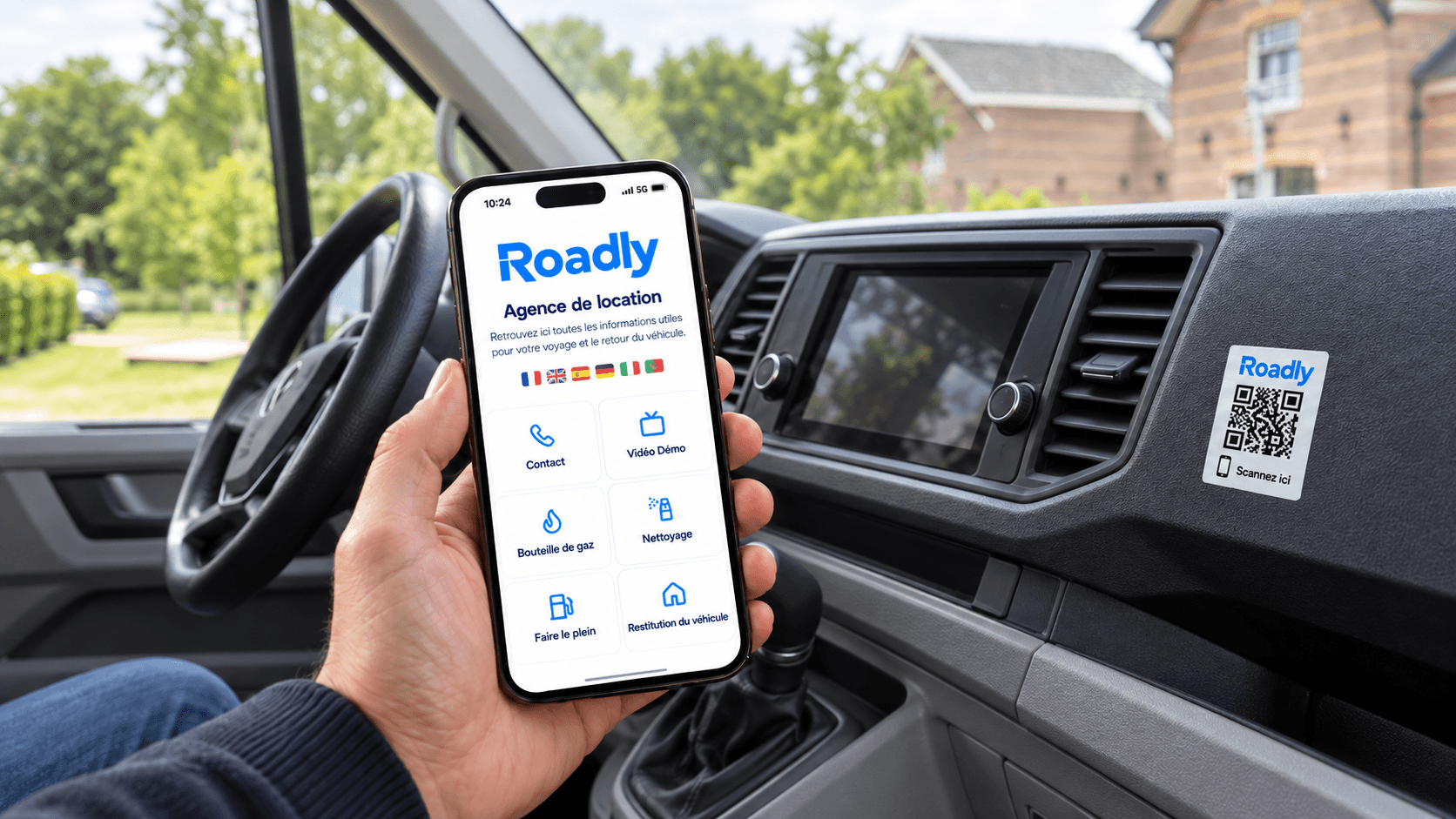
Why QR Codes Are Becoming Essential in Vehicle Rental?
Car rentals, campervans, motorhomes or utility vehicles: the QR Code is emerging as a simple solution to make information easier to access and improve the customer experience.
In the vehicle rental sector, customer experience is no longer limited to handing over the keys. Travellers now expect to access the information they need quickly, without having to search for a manual, contact the rental office or download an extra app.
How does a piece of equipment work? What are the return instructions? Where can you find the support contact details? How do you use the facilities in a campervan?
All of these questions can be answered with a simple QR Code.
For car rental and leisure vehicle professionals, this technology is an opportunity to centralise information, reduce repetitive enquiries and modernise the customer journey, without complicating their operations.
1. Instant Access to Vehicle Information
When a customer picks up a rental vehicle, they often receive a lot of information in just a few minutes: how the vehicle works, terms of use, safety instructions, return procedures and useful contact details.
Yet it is difficult to remember everything at the moment the keys are handed over.
With a QR Code placed directly in the vehicle, the renter can access this information at any time from their smartphone.
Depending on the type of vehicle, a digital information page may include:
- Instructions for getting started with the vehicle.
- Return instructions and return hours.
- Contact details for the rental office and support service.
- User manuals in PDF format.
- Links to tutorials or explanatory videos.
- Recommendations and useful travel information.
A simple scan gives access to essential information, with no app download required.
2. Especially Useful for Campervans and Motorhomes
Renting a campervan or motorhome has specific needs.
Unlike a standard car, these vehicles include many pieces of equipment that travellers are not always familiar with.
Fridge, parking heater, electrical supply, water tank, gas, pop-up roof or wastewater management: each piece of equipment may require specific explanations.
Rental companies therefore have to spend time explaining how everything works, often giving the same explanations at every new rental.
A True Digital Guide On Board
With a QR Code installed in the van or motorhome, travellers can access the essential instructions throughout their trip.
For example:
- Electricity: understanding how the batteries and sockets work.
- Water: locating the tanks and knowing the filling instructions.
- Heating: checking the start-up instructions.
- Kitchen: accessing the equipment manuals.
- Pop-up roof: reviewing the precautions for use.
- Return: checking the steps to complete before returning the vehicle.
The renter becomes more self-sufficient, while the rental company avoids repeating certain explanations.
This approach also keeps instructions available during the trip, when the customer is far from the rental office.
3. Fewer Repetitive Questions for Rental Agencies
At a car rental office, certain questions come up regularly.
« What time should the vehicle be returned? »
« Where should I leave the keys? »
« How do I contact support? »
« Where can I find the rental conditions? »
Even if this information was provided at the start, customers may forget it or need to look it up later.
By grouping these answers on a page accessible via QR Code, professionals can reduce some of the repetitive calls and messages.
Teams then have more time for welcoming customers, preparing vehicles and handling requests that truly require human intervention.
The QR Code does not replace contact with the rental office: it simply makes common information easier to access.
4. Always Up-to-Date Information, Without Reprinting Your Materials
Printed documents have a significant limitation: every change may require replacing them.
A change in opening hours, phone number, return procedure or terms of use can quickly make a document obsolete.
With a dynamic QR Code, the information accessible can be updated without changing the code already installed in the vehicle.
This is particularly convenient for agencies with several vehicles.
Instead of reprinting manuals or replacing documents in each vehicle, professionals can update the information from their management interface.
This reduces the paper materials that need renewing and simplifies information maintenance.
5. A More Accessible Experience for International Customers
Tourism and vehicle rental attract customers with diverse profiles and nationalities.
For an agency located near an airport or in a tourist area, the language barrier can make it harder to convey instructions.
A multilingual digital guide can help international travellers understand essential information.
Customers can then read the explanations in a language they are comfortable with, rather than having to interpret documents available only in French.
This approach is especially valuable for van and motorhome rental companies welcoming international tourists.
This is exactly what ScanPage offers with its automatic translation system. In one click, you can translate your information into several languages and make it accessible to your international customers, with no extra effort.
For safety-related information, however, translations should still be checked to ensure that instructions are perfectly clear.
6. Where Should a QR Code Be Placed in a Rental Vehicle?
The location plays a key role in how the QR Code is used.
It should be easy to spot and access, without obstructing driving or covering any equipment.
Here are some strategic locations for installing a QR Code in a rental vehicle:
- On the centre console: a visible, easily accessible spot when the vehicle is stationary, ideal for checking essential information.
- On the passenger-side sun visor: a discreet spot that makes it quick to find operating instructions and practical information.
- In the glove box: directly on the pouch holding the vehicle documents, for access to manuals and support contact details.
- On the table or furniture of a campervan: ideal for consulting the digital guide, equipment and vehicle instructions.
- Near specific equipment: on a cupboard or suitable surface, close to the heater, fridge or control panel of a motorhome.
- On the contract or key handover document: so customers can access useful information even when they are no longer in the vehicle.
- On a key ring with a QR Code: always within reach, it lets renters quickly access essential vehicle information throughout their rental.
A short message such as « Scan to access your vehicle guide » or « Guide & support » immediately explains its purpose.
The QR Code should be large enough, high-contrast and tested on several smartphones.
7. How to Create a QR Code for Your Rental Vehicles?
Setting up a professional QR Code does not necessarily require developing a mobile app.
With a suitable platform, it is possible to create an information page dedicated to the vehicle or agency, then make it accessible through a QR Code.
Centralise Your Information with ScanPage
ScanPage allows professionals to centralise information and digital content accessible from a simple QR Code.
For car, campervan and motorhome rental professionals, ScanPage makes it possible to:
- Centralise essential information: group instructions, equipment and practical information on a single digital page.
- Share PDF manuals and documents: provide access to user manuals and technical guides for the vehicle.
- Facilitate self-service returns: detail return instructions, parking location, opening hours, key handover and checks to complete before departure.
- Integrate interactive links: direct customers to tutorials, videos or additional services.
- Automatically translate content: make information available in several languages, in one click.
- Update information at any time: modify content without having to reprint QR Codes that are already installed.
- Analyse advanced viewing statistics: track the number of scans and discover which content and links your customers click on, to better understand their needs and interests.
With ScanPage, simplify the management of your rentals, give your customers more independence and reduce repetitive requests to your teams, all with a simple QR Code.
Conclusion: A Small QR Code to Simplify an Entire Rental
Digitising vehicle rental does not necessarily require complex or costly solutions.
A QR Code, combined with a well-structured information page, can already considerably improve the way information is conveyed to renters.
For car rental agencies, it makes practical instructions easier to access. For campervan and motorhome rental companies, it can become a true digital guide on board.
Fewer paper documents, more accessible information and greater independence for customers: the QR Code is a simple tool for modernising the rental experience.
And for professionals ready to take the next step, solutions like ScanPage make it possible to set up this kind of experience without any particular technical skills.